Most flat-tire disasters happen before the wrench ever comes out. Here are the mistakes that turn a simple spare change into a long, unsafe wait on the shoulder.
Road notes
- Check that the spare, jack, lug wrench, chocks and warning triangles are actually in the car, and learn where your spare is mounted before a trip.
- Spares lose air too, about 1.5 psi per month naturally, so check spare pressure with a gauge monthly and before long drives.
- Use the jack points shown in your owner’s manual, usually notched tabs on the frame, and never place a jack under bodywork.
- A compact donut spare is built for about 50 miles at up to 50 mph, so get the regular tire repaired or replaced within a day or two.
- Get fully off the road onto a level, well-lit spot, keep passengers away from traffic, and never put any body part under a jacked-up car.
A flat tire is one of the few roadside problems a driver can fix alone, and one of the few where preparation decides everything. Most failed tire changes have nothing to do with strength or mechanical skill. The spare is flat, the jack is buried under luggage, or the lug wrench is missing. These mistakes are common, predictable, and much easier to fix at home than on a shoulder at dusk.
Mistake 1: Assuming the Spare, Jack and Tools Are Actually in the Car
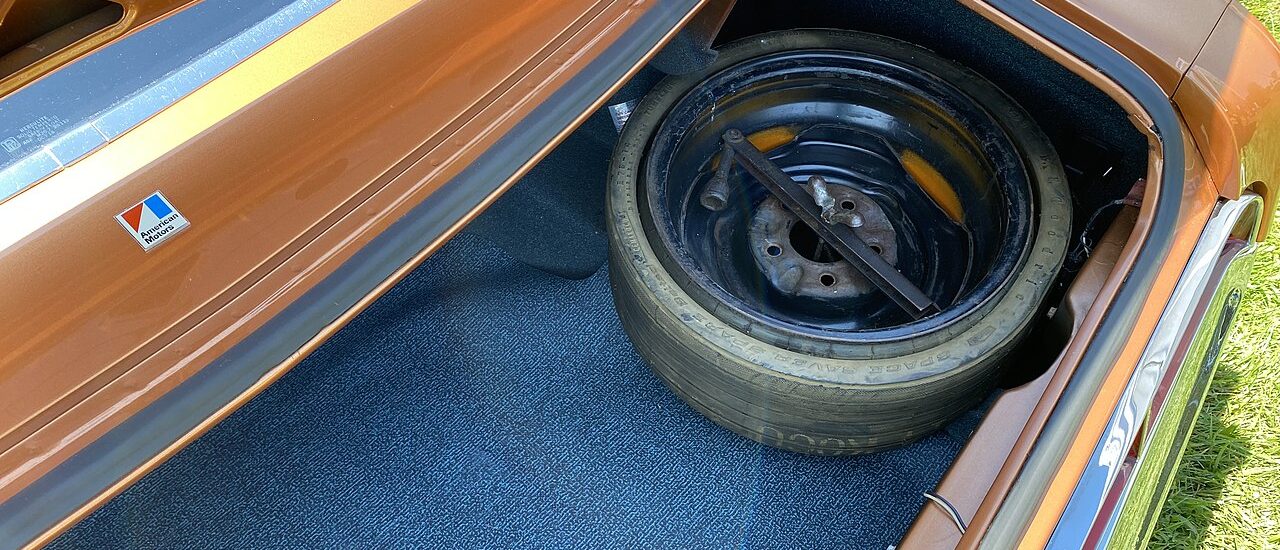
Many drivers have never opened the compartment where their spare lives. Depending on the vehicle, the spare may sit in the trunk, mount on the tailgate, or crank down from under the cargo area, and some vehicles carry no spare at all, just a sealant kit. The owner’s manual tells you where to look on your specific model.
Pull everything out before a trip, not during one. A complete kit includes a jack, a lug wrench and a properly inflated spare, plus a tire gauge, a flashlight and gloves. Wheel wedges or a couple of bricks keep the car from rolling, and warning triangles or flares make you visible to traffic. Missing items are cheap at a hardware store and expensive on the roadside. Our pre-road-trip car checkup takes another 20 minutes and covers the rest of the car while you are at it.
Mistake 2: Never Checking the Spare’s Pressure (Yes, It Goes Flat Too)
Spare tires lose air just like the ones touching the pavement. Tires naturally lose as much as 1.5 psi per month, and cold weather knocks off about 1 psi for every 10 degree Fahrenheit drop in temperature. A spare that was fine three winters ago can be dangerously soft today, and underinflation is difficult to spot by eye.
Check the spare with a gauge monthly and before any long trip, the same schedule as your other tires. The correct pressure is printed on the label in the driver’s door frame or listed in the manual. Compacts often need a much higher pressure than regular tires, so do not guess. If the spare uses a special bottle or inflator, confirm that is in the car too.
Mistake 3: Not Knowing Your Jack Points Before You Slide a Jack Under
Jack points are specific spots under each side of the vehicle designed to hold its weight. On many cars they are notched tabs along the frame. Put a jack anywhere else and you can crush plastic bodywork, damage lines underneath, or watch the car slip off the jack. The owner’s manual marks the exact spots for your model, and some cars repeat the instructions on a decal near the spare.
A few habits make lifting safer:
- Park on solid, level ground, never on a grade, and avoid dirt or grass, which can let the jack sink.
- Set the parking brake and wedge a rock or chock against the tire diagonally opposite the flat.
- Loosen the lug nuts while the tire is still on the ground, then use the jack to lift the car until the flat tire hangs clear of the pavement by roughly an inch and turns without dragging.
- Slide the flat wheel under the car once it is off. If the jack fails, the car will not fall far.
- Keep every body part out from under the vehicle and out of the wheel well the entire time.
Practice the jack’s crank or scissor action at home, in daylight, so you are not learning it in the rain at night.
Mistake 4: Treating a Compact Donut Like a Normal Tire
A compact temporary spare is a one-trip tire. Most automakers advise no more than about 50 miles and no faster than 50 mph, and some list up to 70 miles as an upper limit, not a target. The exact figures usually appear on a label stuck to the spare’s wheel or as lettering formed into the sidewall itself, and they override any general rule.
Exceeding the limits is not a technicality. A donut has little tread and less traction, and past its rated distance the thin tread wears quickly while the risk of a blowout rises. The smaller diameter can also strain a vehicle’s differential and drivetrain, and some all-wheel-drive vehicles are not compatible with compact spares at all. Plan to reach a tire shop within a day or two, not to finish the trip.
Two related notes. A full-size spare that does not match your other tires in size, type and construction should be treated as temporary as well. And age matters even on a true match: rubber breaks down over time whether the tire is used or not, and tire manufacturers generally advise replacing a tire once it reaches somewhere between six and ten years of age.
Mistake 5: Stopping in the Travel Lane Instead of Getting Fully Off the Road
The safest places to change a tire are a parking lot, a side street or a highway exit ramp, where speeds are lower. If none of those are close, pull onto the right shoulder as far as you can, on solid, level ground on a straight, well-lit stretch. Driving a short distance very slowly to reach a safe spot is better than stopping in a bad one, since rolling on a flat can damage the wheel.
Once stopped, turn on the hazard lights, set the parking brake, remove the keys from the ignition, and set out warning triangles or flares if you carry them. Get passengers out of the car and well away from the road, and wait outside the vehicle itself, because a stopped car near traffic can be hit. Our step-by-step guide to roadside breakdowns covers what to do from the first thump to the tow.
Mistake 6: Relying on Tire Sealant When It Doesn’t Fit the Damage
Some vehicles carry a sealant and inflator kit instead of a spare. Sealant can handle certain small tread punctures, but it is a temporary fix, not a repair, and it cannot help with every flat. A blowout, a cut sidewall or a large gap needs a spare or a tow, and a damaged or flat spare is not safe either. Roadside assistance technicians will install or reinflate a spare, and if there is no usable one, the vehicle can be towed to a repair shop. Know which setup your car has before you leave home, and know the limits of a kit before you count on it.
A 15-Minute Practice Session That Makes the Real Thing Easy
In the driveway, with daylight and no pressure, run through the whole change once:
- Find the spare, jack, lug wrench and chocks. Confirm nothing is missing.
- Check the spare’s pressure with your gauge.
- Read the jack-point section of the manual and find the tabs under the car.
- Loosen one lug nut on a real wheel and retighten it.
- Lift the car until the tire clears the ground, lower it, and stow everything back where it belongs.
Fifteen minutes at home teaches you the crank direction, the jack’s reach and where the tools live. The real flat will still be annoying, but it will not be a surprise.
Spare tires, jacks and warning triangles belong with the rest of your trip gear, and our timeline for packing the car shows where to stow them so they are reachable when it counts. Check the spare along with everything else before the wheels start rolling.
Questions from the road
Q: How far and how fast can I drive on a donut spare?
A: Most automakers advise no more than about 50 miles and no faster than 50 mph, and some list up to 70 miles as an upper limit. The exact figures appear on the spare’s sidewall or on a label attached to the wheel, and those limits always take priority.
Q: How often should I check my spare tire’s pressure?
A: Check it with a gauge monthly and before every long trip, the same schedule you use for the tires on the ground. Tires naturally lose as much as 1.5 psi per month, and underinflation is difficult to detect by eye.
Q: Can I change a tire on the shoulder of the highway?
A: Only if you have no better option, and then only on solid, level ground on a straight, well-lit stretch as far from traffic as possible. A parking lot, side street or exit ramp is much safer, and driving a short distance very slowly to reach one beats stopping in a bad spot.
Q: Is tire sealant a substitute for a spare tire?
A: No. Sealant can handle certain small tread punctures as a temporary fix, but it cannot help with a blowout, a cut sidewall or larger damage. Know whether your car carries a spare or a sealant kit, and what each one can and cannot do.
Road rules, fees, closures and border requirements change. Check with the state transportation department, park, rental company or border agency before you travel. This guide is general information.